
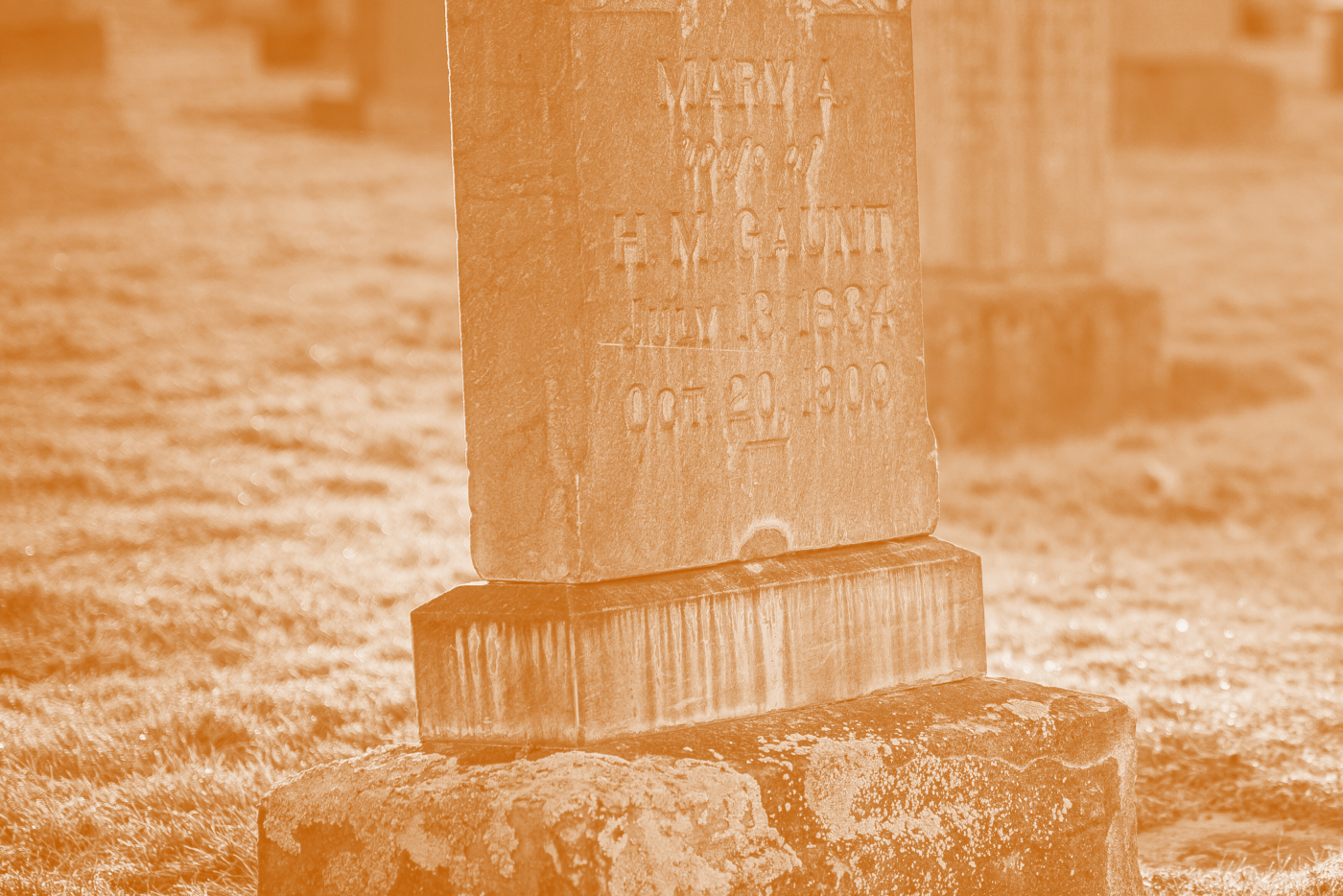

Abbotts Creek Primitive Baptist Church Cemetery.
On a rainy Saturday afternoon in October, OSA Historic Cemetery Program staff trekked over to Davidson County. The goal was to check out a type of historic headstone unique to North Carolina. The pierced headstone tradition developed in the early decades of the 19th century thanks to a very particular intersection of culture, trade, timing, and geology.
German immigrants and their families migrated from their new homes in Pennsylvania, Maryland, and Virginia into northern North Carolina at the end of the 18th century and into the early 19th century. Many of the new North Carolinians were farmers by trade. As a side job, some took up cabinetry. Together, the makers developed a style of construction and design that was distinctly northern NC piedmont. In the Davidson County area, they were known as The Swisegood School of Cabinetmaking.

Corner cupboard attributed to Jacob Clodfelter, ca. 1795. Photo courtesy of Museum of Early Southern Decorative Arts.
Besides cupboards, bedframes, chests, tables, and other furniture, early American cabinet makers were often assigned a heavier role: coffin maker. They had the tools, the skills and the planed lumber necessary to help their neighbors through a difficult task. In legendary preservationist and cemetarian Ruth Little’s research, she uncovered Davidson County estate records that ensured money was set aside for cabinet maker Joseph Clodfelter to make two coffins (Lucas 2015).
For Clodfelter, David Sauer (Sowers), and other Davidson County makers, local geology allowed them to go one step further. Farmers turned cabinet makers turned coffin makers, started carving headstones. Thus was born a headstone tradition that cannot be found anywhere else in the U.S. or Europe- pierced headstones.
Soapstone (also known as steatite) is found all across the piedmont and mountain counties of North Carolina. It is a metamorphic rock made up primarily of talk with a soft, smooth texture. The surface feels waxy or even soapy, particularly when wet. Native peoples of North Carolina have used the material for centuries to carve bowls, pipes, effigies, and more. The famous Judaculla Rock in Cullowhee is soapstone.
Soapstone is very easy to carve. This means that the Davidson County cabinet makers already had the tools and the skills to take a local stone and create a new category of furniture: headstones. As you will see below, the beautiful baroque and neoclassical elements that had become the trademark of the Swisegood School were easily replicated on these markers.


Left, from Abbotts Creek Primitive Baptist Church Cemetery. Right, from Beck’s Reformed Church Cemetery.
In addition to scrollwork and fluting borrowed from their cabinet trade, they also included imagery and typefaces seen in German religious traditions and important paperwork. These include the fylfot cross (pinwheel) used to symbolize eternity, tulips, tree of life, hearts, chevrons, celestial objects, rays of light and more.


Note the fylfot cross in the center of headstone at left (Beck’s Reformed Church Cemetery). On right, engraved stars and rays of light (Pilgrim Reformed Church Cemetery).
Joseph Clodfelter is often credited as being one of the earliest Swisegood Cabinetmakers to produce headstones where the motifs pierce all the way through the stone, create a window for light to come through. Earlier makers, maybe including Joseph’s father, carved their beautiful designs deep into the soft surface of the stone (Little 1998). Starting around 1802, Joseph’s carvings carefully punched all the way through, creating lacy baroque tympanums (the shaped part of a headstone at the top), swirling pinwheel fylfot crosses, curling tulips, and resting crescent moons.


A carved soapstone marker (Pilgrim Reformed Church Cemetery) versus a Joseph Clodfelter-style pierced stone (Abbotts Creek Primitive Baptist Church Cemetery).
David Sauer (Sowers) was another Swisegood School maker who dabbled in headstones. However, he developed his own style, only including the piercing later (1820s) when Clodfelter’s style was too popular to not take advantage of (Little 1998). Sauer’s style leaned more on gothic forms and traditional German symbols (Little 1998).


Sauer markers at Pilgrim Reformed Church Cemetery.
The symbols and distinctive font were likely adopted from ornate German certificates called Frakturs, which recognized events like births, baptisms, marriages, and deaths (Farlow 2006). These headstones were essentially acting as death notices. Much like obituaries. The accompanying symbols communicate eternity, everlasting love, hope, and everlasting life.


From Pilgrim Reformed Church Cemetery.
On an interesting note, Ruth Little (1983, 1998) describes how you can see that these stones weren’t carved by professionally trained stonecutters or monument makers. On some, the letter spacing was not quite even. Capitalized and even backwards letters pop up in unconventional places. But who could blame them? Afterall, stone carving was sometimes their fourth or fifth skilled trade!

From Pilgrim Reformed Church Cemetery.
Pierced headstones remained popular in Davidson County from the early 1800s through the 1850s. If you are interested in seeing these beauties for yourself, plan a trip to High Point and Lexington. National Register for Historic Places listed cemeteries that contain pierced headstones include Beck’s Reformed Church Cemetery (Lexington), Pilgrim Reformed Church Cemetery (Lexington), and Abbotts Creek Primitive Baptist Church Cemetery (High Point).
PLEASE heed any cemetery rules, signage, and access restrictions. These stones are fragile due to age and the softness of the soapstone. It is very important that you do not lean on, clean, or touch them. Do not attempt grave rubbings. Use your phone or camera to capture these amazing works of art with the knowledge that you’re witnessing something you can’t see anywhere else!

Abbotts Creek Primitive Baptist Church Cemetery.
References to learn more:
Farlow, Shannon
2006 “Stone Foundation.” Our State. May 2006. < http://www.slusher.org/Stone%20Foundation.pdf?fbclid=IwY2xjawVQbgdleHRu…;.
Litte, Ruth M.
1983 Individual Property Form for Anglo-German Cemeteries. National Register Nomination. < https://npgallery.nps.gov/NRHP/GetAsset/NRHP/64000444_text>.
1998 Sticks and Stones: Three Centuries of North Carolina Gravemarkers. University of North Carolina Press, Chapel Hill.
Lucas, June
2015 “Piedmont North Carolina’s Swisegood School of Cabinetmaking: Expanding the Narrative, 1770-1858.” Museum of Early Southern Decorative Arts. Journal of Early Southern Decorative Arts. < https://www.mesdajournal.org/2015/piedmont-north-carolinas-swisegood-school-cabinetmaking-expanding-narrative-1770-1857/>.
To learn more about Judaculla Rock: https://www.visitnc.com/judaculla-rock